> ## Documentation Index
> Fetch the complete documentation index at: https://quester.mintlify.site/llms.txt
> Use this file to discover all available pages before exploring further.
# Build your source library
> Why the source library anchors the project, how to keep it useful, and how much literature to bring in.
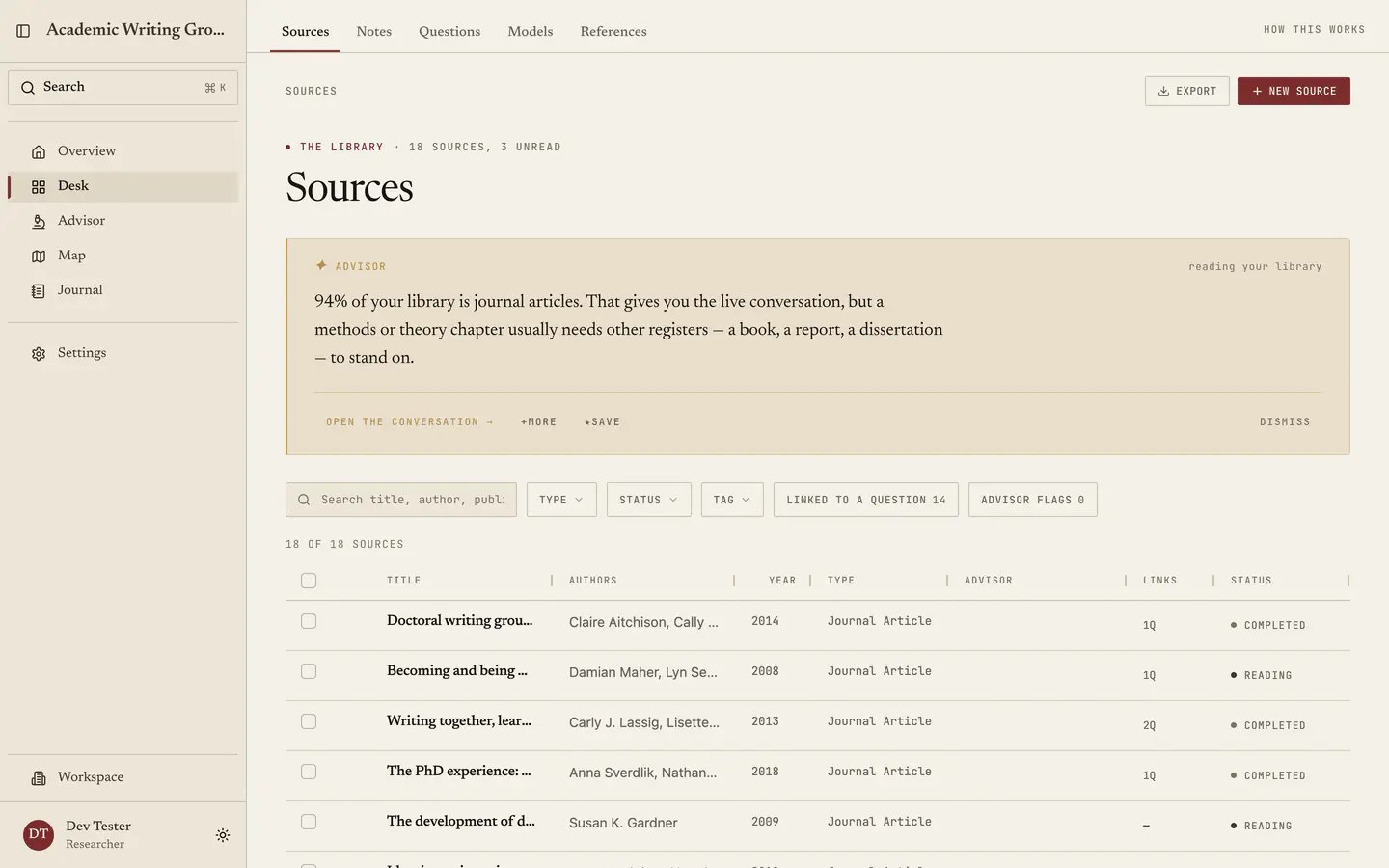
Sources is the first tab of the Desk and the foundation everything else stands on. The Advisor can only discuss what is here, the Map can only analyse what is here, and References can only cite what is here. Once a source lands, Quester pulls its metadata, extracts text where there is a file, and connects it to your questions and notes.
 ## Put literature here first
Bring the library in before you try to learn anything from the Map or the Advisor. A reference-manager export is the fastest route for an existing corpus; documents and pasted references cover the material that has not reached your manager yet.
Follow the procedure for BibTeX, RIS, documents, pasted references, and manual records.
Look up queue states, failed documents, source limits, and exports.
## Finding things again
Search the list by title, author and publisher, and filter by **status** and by **advisor flag**.
Status is yours to set and it earns its keep, running **Not started**, **Reading**, **Note taking**, **Completed** and **Archived**. Keep it current and a pile of two hundred PDFs turns into a work queue where "what am I in the middle of" is one click, and you can set it from the list or from a source's own page.
The columns are what you would expect: title, authors, status, publisher, year, type, date added, and whether a file is attached.
## How much to bring in
More than feels comfortable, and earlier than feels ready.
The analyses in [the Map](/manual/map-overview) need a corpus before they can say anything true, since theme clustering over eight sources tells you about those eight sources and nothing about your field. Composition, terms and trends all sharpen as the library grows, and the Advisor's first read is only as specific as the material behind it.
The opposite instinct, which is curating carefully and importing only what you have read, costs you the exact thing the tool is for, namely seeing the shape of a body of literature you have not fully absorbed yet. Bring in the whole reading list and use status to mark what you have actually read.
Next: [Reading a source](/manual/source-detail).
## Put literature here first
Bring the library in before you try to learn anything from the Map or the Advisor. A reference-manager export is the fastest route for an existing corpus; documents and pasted references cover the material that has not reached your manager yet.
Follow the procedure for BibTeX, RIS, documents, pasted references, and manual records.
Look up queue states, failed documents, source limits, and exports.
## Finding things again
Search the list by title, author and publisher, and filter by **status** and by **advisor flag**.
Status is yours to set and it earns its keep, running **Not started**, **Reading**, **Note taking**, **Completed** and **Archived**. Keep it current and a pile of two hundred PDFs turns into a work queue where "what am I in the middle of" is one click, and you can set it from the list or from a source's own page.
The columns are what you would expect: title, authors, status, publisher, year, type, date added, and whether a file is attached.
## How much to bring in
More than feels comfortable, and earlier than feels ready.
The analyses in [the Map](/manual/map-overview) need a corpus before they can say anything true, since theme clustering over eight sources tells you about those eight sources and nothing about your field. Composition, terms and trends all sharpen as the library grows, and the Advisor's first read is only as specific as the material behind it.
The opposite instinct, which is curating carefully and importing only what you have read, costs you the exact thing the tool is for, namely seeing the shape of a body of literature you have not fully absorbed yet. Bring in the whole reading list and use status to mark what you have actually read.
Next: [Reading a source](/manual/source-detail).