

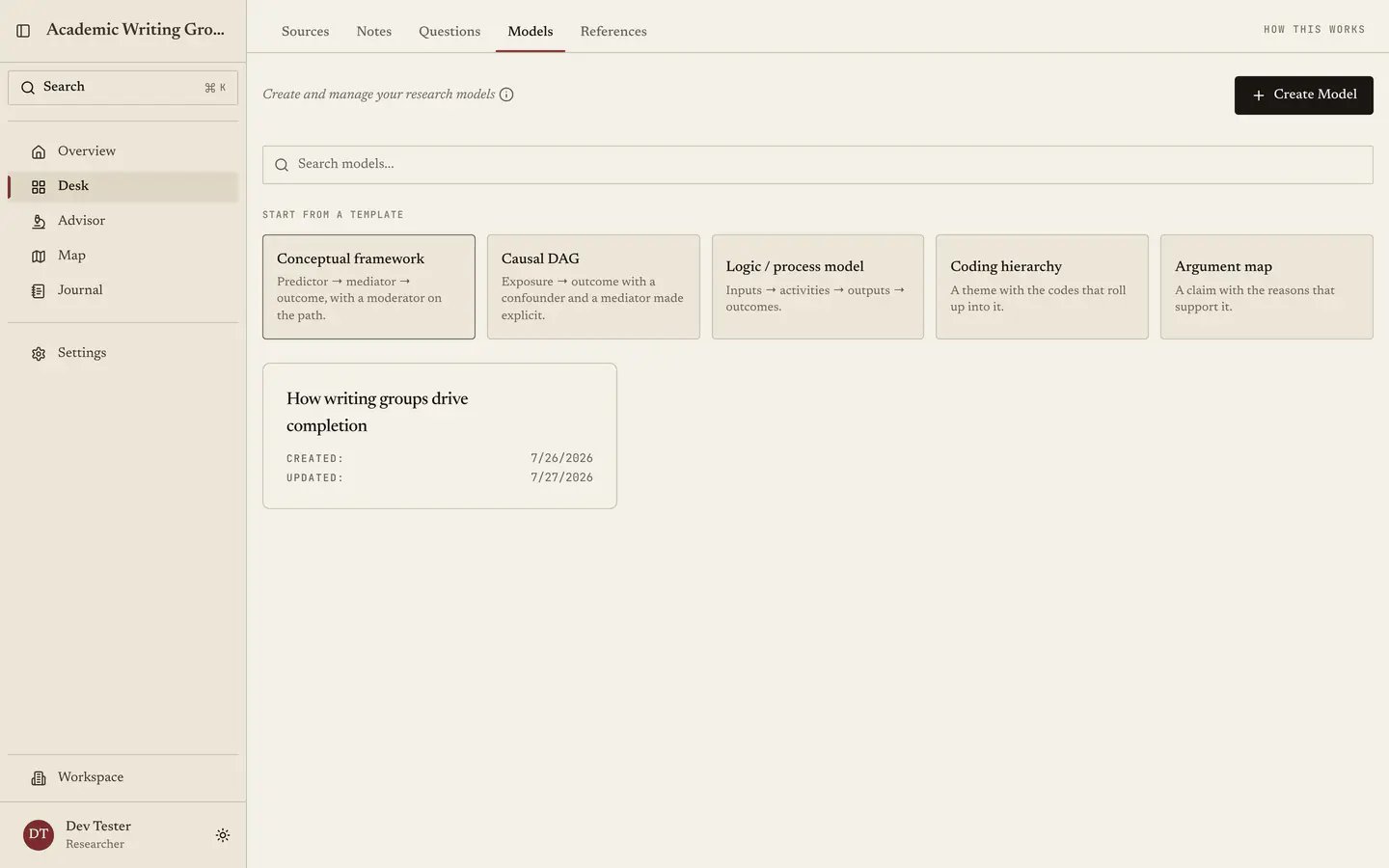
Starting from a template
Seven templates, each pre-built with the right shape so you start by editing instead of staring at a blank canvas. Each one carries a line saying what the diagram asserts, which is the thing to read before you pick:- Conceptual framework. Predictor → mediator → outcome with the direct path, and a moderator on the mediated path. A causal chain with its mechanism named. Reach for it when you can say how the predictor reaches the outcome and what conditions that path.
- Causal DAG. Exposure → outcome with the direct path, a confounder and a mediator made explicit. Your causal assumptions drawn for identification. Reach for it to decide what to adjust for before estimating an effect.
- SEM (latent mediation). Two observed predictors → a latent mediator → an observed outcome, with direct paths, an exogenous covariance, and error terms. A mediation model whose mechanism is a latent construct, which is what you want when the mediator is something you infer rather than measure, and the ellipse, the double-headed arrow and the two disturbances are all doing methodological work rather than decorating.
- Logic / process model. Inputs → activities → outputs → outcomes. A programme’s route from resources to results, for planning or evaluating an intervention rather than proving causation.
- Coding hierarchy. A theme with the codes that roll up into it. The theme is derived from its codes, which is the direction the arrows encode, and it is what you want when synthesising qualitative coding.
- Argument map. A claim with the reasons for and against it, typed as support and contradiction rather than cause, for stress-testing a conclusion before you commit to it.
- PRISMA 2020 flow. The systematic-review flow diagram, counted from your own library: how many records entered the review and how many survived each stage. See the PRISMA 2020 flow, since it works differently from the other six.