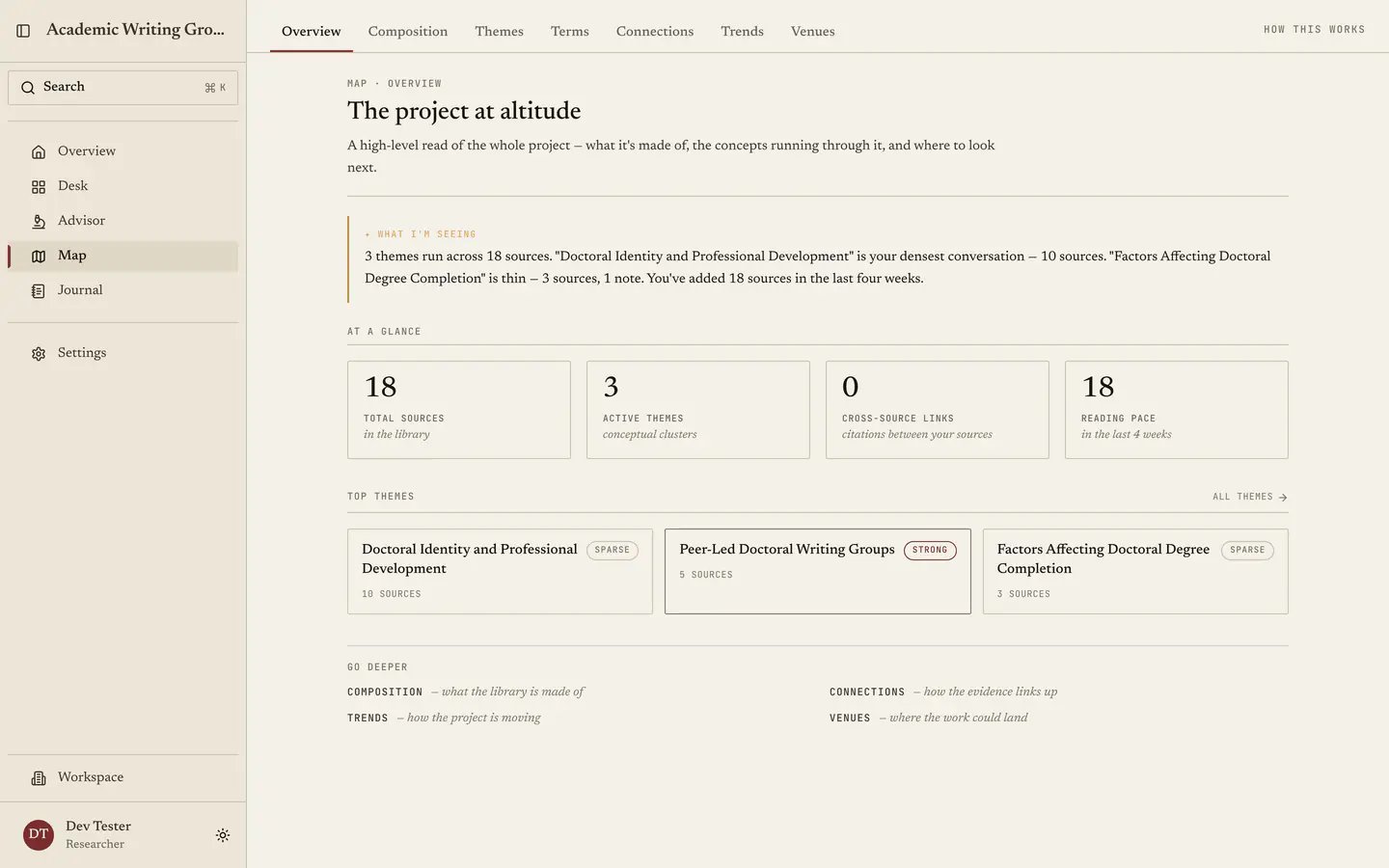
The Map is the analytical view of your library, showing not what you put in it but what it turns out to look like from a distance, across seven tabs that give you seven lenses on the same corpus. This one is the altitude read, with a gold summary card, a row of stat cards describing the collection, your top themes, and pointers into the deeper tabs. Overview is free. Authored theme tiles remain visible on every plan, while generated theme analysis needs a paid plan. The Map overview: a gold summary card over the stat cards describing the corpus, with top themes below.

The summary card

The gold card at the top summarizes the numbers below it and your theme data. You can check every claim against the deeper tabs.

At a glance

Four stat cards describe the collection:
  • Total sources. How big the corpus is.
  • Active themes. How many visible authored and generated themes the project contains.
  • Cross-source links. How connected it is, since a library where nothing links to anything is a reading list while one with dense links is a literature.
  • Reading pace. How fast it is growing.
Watch cross-source links, because it marks the difference between having read forty papers and having a body of literature, and it is not something you can feel from the inside.

Top themes

The leading authored and generated themes in your library, shown as tiles, each of which opens the full Themes tab. Authored tiles are labelled so they are not mistaken for generated clusters. Use this as a quick check on whether your corpus is about what you think it is about. An unexpected theme near the top usually means one of two things: either you have been reading more widely than you realised, or you have imported a body of work that is not really yours to review. Both are useful to find out.

Go deeper

Pointers into the six other lenses, where which one to open depends on your question:
  • What is my library made of?Composition
  • What concepts run through it?Themes
  • How does my field use these words?Terms
  • How do my sources relate to each other?Connections
  • How has my project moved?Trends
  • Where could this work land?Venues

When the Map is worth opening

Not daily, since the Map answers questions about a body of work and a body of work barely changes in a day. It earns its keep in four moments: before writing a literature review, when the shape of the corpus becomes the shape of the chapter; when you suspect you have been reading in a rut; before a committee meeting, where someone will ask what your literature actually covers; and after importing a large batch, when you want to know what arrived.

One caveat

Every reading here describes your library rather than your field, so if your corpus is thirty papers you picked, the Map tells you about your picking. That is useful, since almost nobody can see their own selection bias, but it is not a claim about the state of the discipline. Terms is the one tab that reaches past your corpus, counting against the published record, while the rest read what you brought in. Next: Composition.
Last modified on August 30, 2026