Concepts and relationships
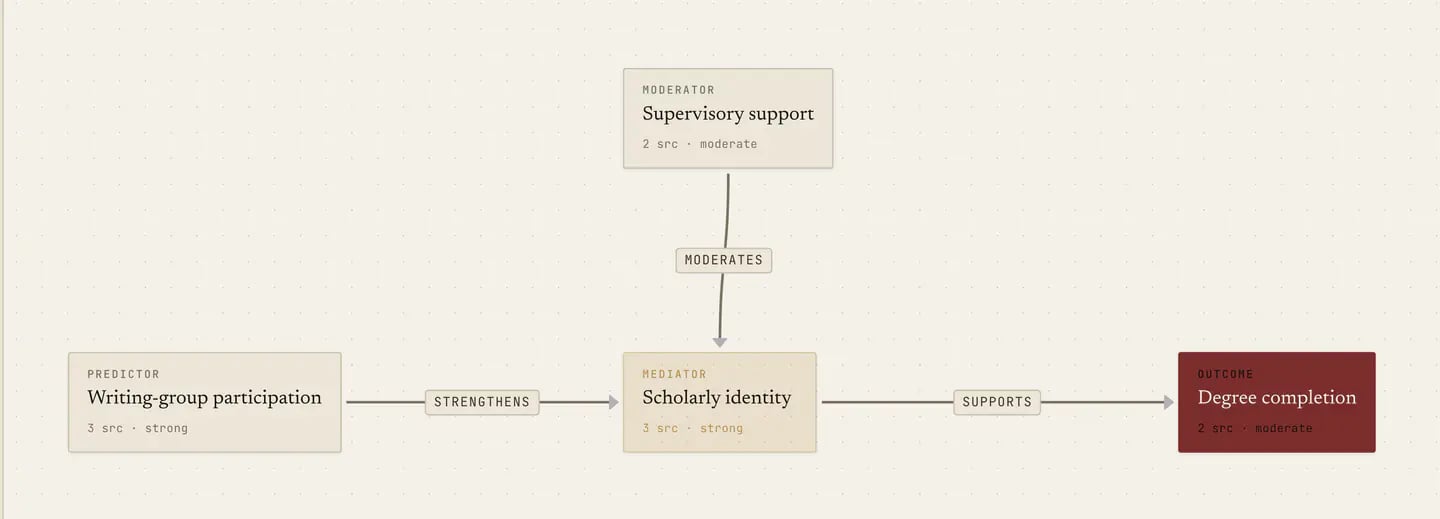
Two kinds of thing live on the canvas. Concepts are the boxes, meaning the constructs, variables, themes or claims your model is made of, and you should name each one properly, since an unnamed concept is just a shape. Relationships are the arrows between them, and every arrow carries a claim, which is why you can type one Supports or Contradicts and label it with what the relationship actually is. This is where a diagram stops being a picture, because “A → B” says nothing whereas “A → B (supports: increases uptake, mediated by trust)” is a claim someone can dispute. Plain shapes such as rectangles, circles and ellipses handle grouping and annotation, with the usual styling underneath for colour, border, opacity, text alignment and layering, while grid and snap-to-grid sit in the toolbar and you can export the canvas as an image on a background of your choosing.SEM notation
If you are drawing a path or structural equation model, the canvas follows the conventions your reader already knows, taken from Kline’s Principles and Practice of Structural Equation Modeling. Measurement, in the concept inspector, decides the shape. Observed is a rectangle, meaning something you measured directly, and it is what every concept starts as. Latent is an ellipse, meaning a construct you infer rather than measure. Nothing you have already drawn changes, since a concept with no measurement set reads as observed. Add error term puts a small circle beside a variable with a single-headed arrow running into it, which is the disturbance, standing for the variance your model leaves unexplained. It is only offered on endogenous variables, meaning ones something else in the model points into, because a variable nothing predicts has nothing left unexplained, and each variable gets one. Delete the variable and its error term goes with it. Draw a line between two error terms and you get a correlated-errors arc, double-headed, as the convention wants. Covariances are double-headed. Any relationship you type correlates with is drawn with an arrowhead at both ends, since a non-directional claim should not point one way, and the start-arrow control is set for you on those arrows. One thing the canvas deliberately leaves to you is the direction of your indicator arrows. A reflective model points from the construct out to its indicators while a formative one points inward, both are legitimate, and which you mean is your claim to make rather than ours to correct.Binding concepts to sources
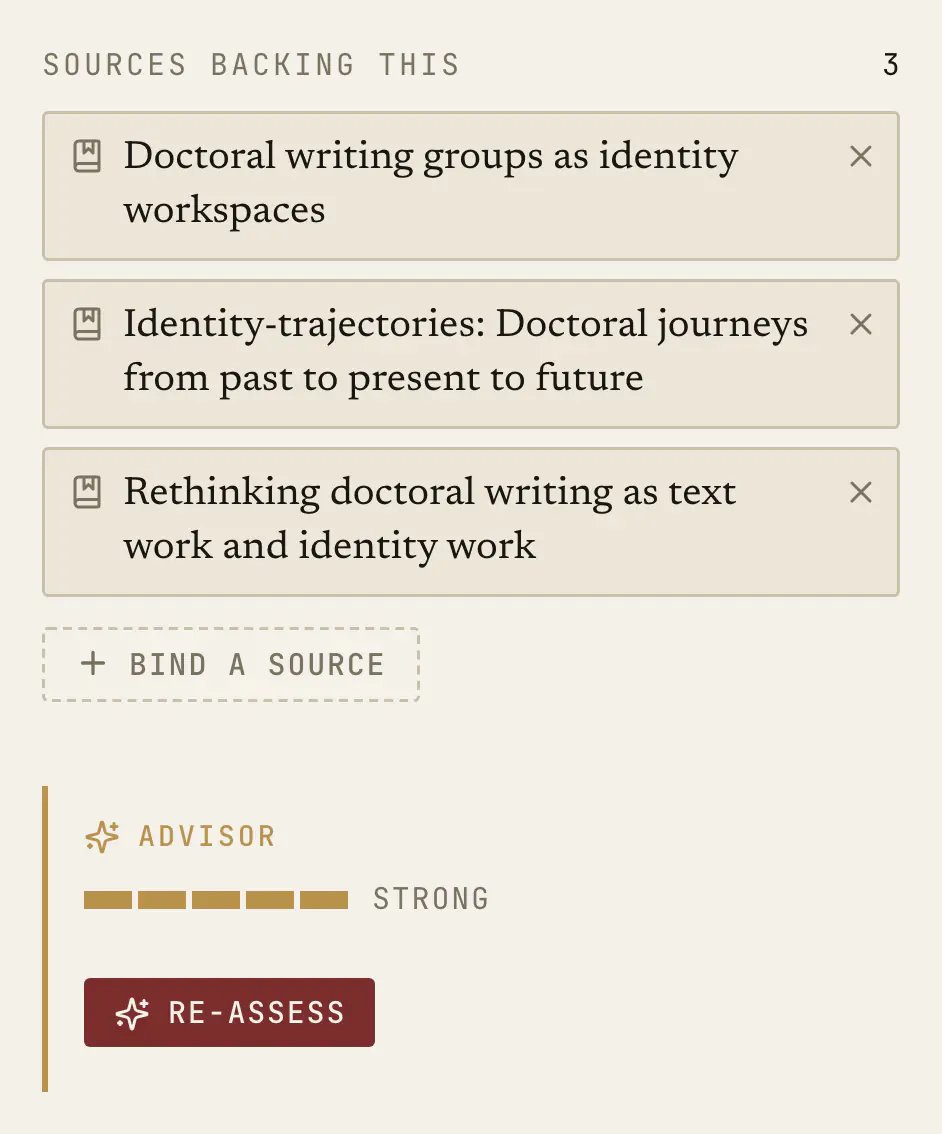
Select a concept and use the inspector to bind sources to it from your library, with search.